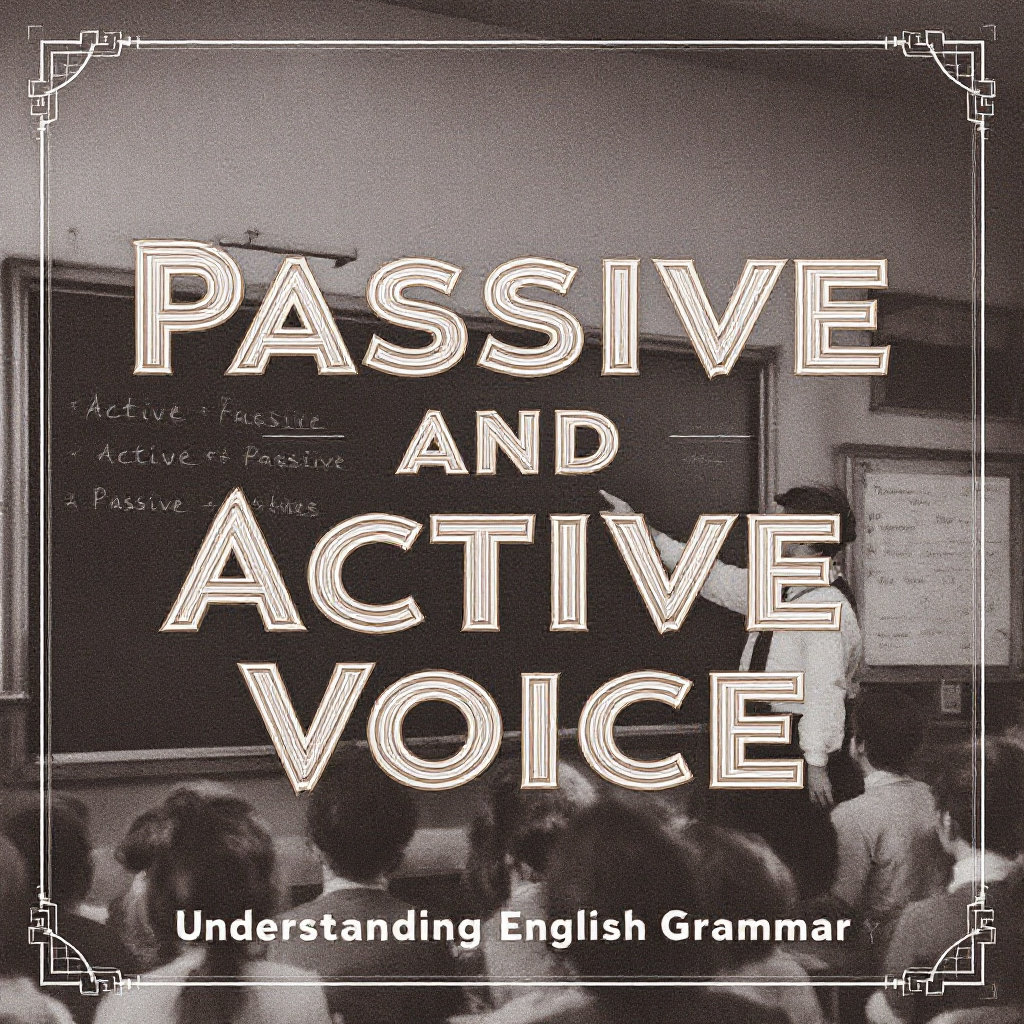
📝 Confused between passive and active voice in English? In this video, we break down the difference between active and passive voice, explain when to use each one, and provide clear examples to help you understand and use both effectively in your English writing and speaking.
🔹 What You’ll Learn in This Video:
✅ The difference between active and passive voice
✅ When and why to use each voice
✅ Examples of active and passive sentences
✅ How to change a sentence from active to passive
✅ Common mistakes to avoid with voice usage
🔹 1️⃣ What is Active Voice?
In active voice, the subject of the sentence performs the action. The focus is on the doer of the action.
Structure:
Subject + Verb + Object
Example:
Active Voice: The teacher explained the lesson.
Explanation: Here, the teacher (subject) is doing the action (explained).
🔹 2️⃣ What is Passive Voice?
In passive voice, the object of the action becomes the subject of the sentence. The focus is on the action itself or the recipient of the action, not the doer.
Structure:
Subject + Verb (to be) + Past Participle + (by + Agent)
Example:
Passive Voice: The lesson was explained by the teacher.
Explanation: The focus is now on the lesson (subject), and the doer (teacher) is mentioned at the end, or not at all.
🔹 3️⃣ When to Use Active and Passive Voice:
Active Voice: Use it when the subject of the sentence is important, or you want to emphasize who is doing the action.
Example: She wrote a letter.
Passive Voice: Use it when the action or the recipient of the action is more important than the doer, or when the doer is unknown or irrelevant.
Example: The letter was written by her. (The action of writing is more important than who did it.)
🔹 4️⃣ Changing from Active to Passive:
To change an active sentence to passive:
Make the object of the active sentence the subject of the passive sentence.
Add a form of the verb to be according to the tense.
Use the past participle of the main verb.
Optionally, add the original subject at the end with “by.”
Active: She wrote a letter.
Passive: A letter was written by her.
🔹 5️⃣ Common Mistakes to Avoid:
Confusing verb tenses:
Incorrect: A letter writed by her.
Correct: A letter was written by her.
Not using the correct form of “to be”:
Incorrect: A letter is wrote by her.
Correct: A letter is written by her.
🎯 Why Watch This Video?
✅ Master the use of active and passive voice
✅ Learn how to make your writing more varied and dynamic
✅ Avoid common mistakes with voice usage
✅ Improve your ability to communicate clearly in English